Trust and timing are the core of the real estate industry. Much of the business here depends on conversations. A potential buyer calling up might seem like just another inquiry amid many others in your busy day, but it can also be the start of a real deal. A quick response helps build trust, maintain the prospect’s interest, and lead the conversation one step closer to closing the deal. But a missed call, on the contrary, can send them looking elsewhere.
When you are a real estate team dealing with numerous routine queries, meetings, and follow-up calls daily, important calls often risk taking a back seat. This is when an AI voice agent for real estate can become your assistant in handling much of the routine operations. It can manage interactions, starting with answering questions about properties, qualifying leads, arranging site visits, and callbacks with prospects. Your teams get the opportunity to build stronger relationships with customers and deliver their expertise instead of getting stuck in the constant loop of routine tasks.
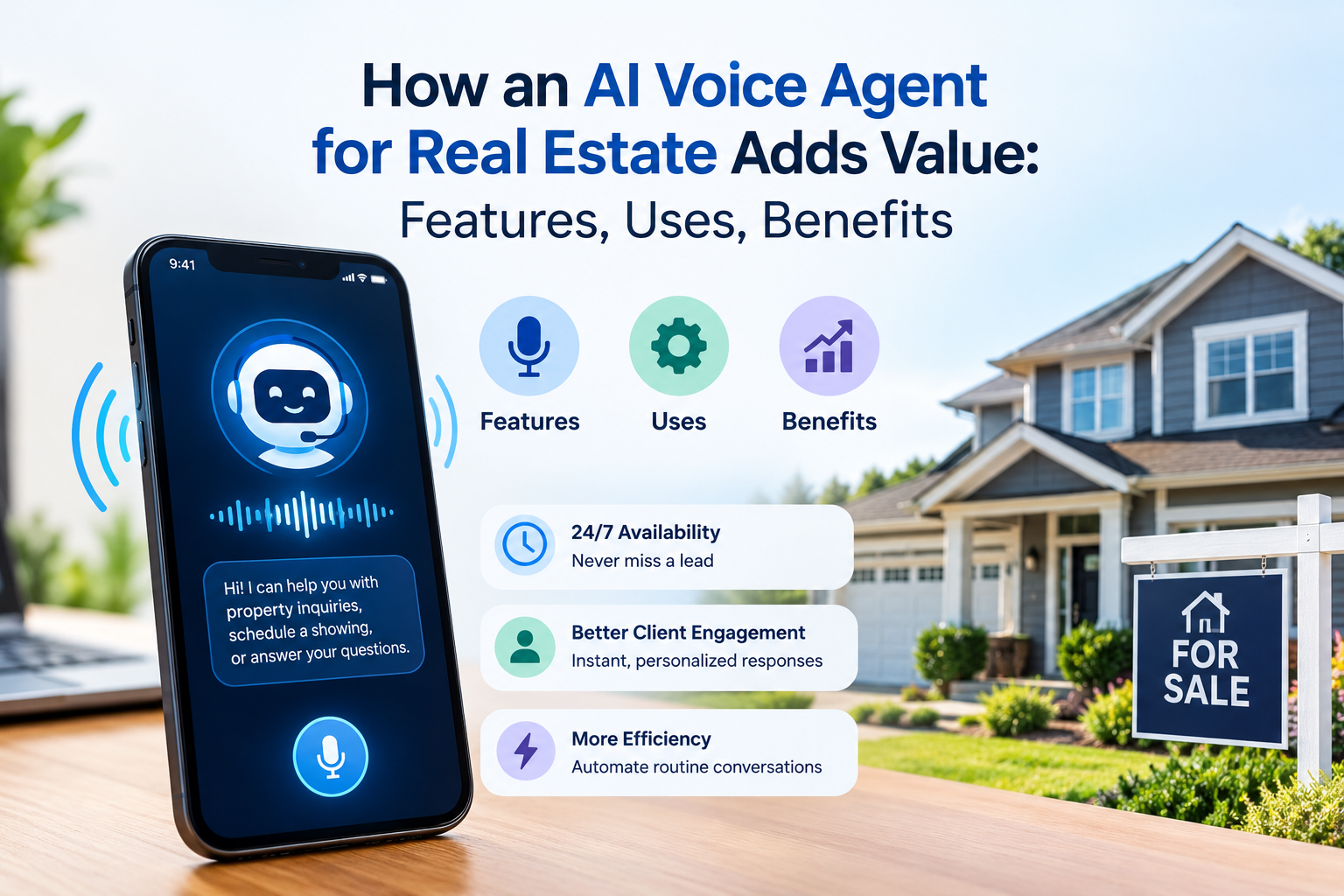
What does an AI voice agent for real estate do on a call?
A property-related call can involve several things. A typical caller may start by asking routine questions before coming to a decision. want to know property availability, discuss budget and location, or request a site visit. Potential buyers, on the other hand, would want to know about property availability, discuss budget, or request a site visit. An AI voice agent for real estate can handle these interactions in sequence, gathering the information needed and taking the next step based on the caller’s response. Here’s how it manages common real estate calls.
Answer property questions
Property price, size, amenities, and availability are routine questions. The AI agent looks them up in your brokerage records or a connected listing source. That could be an MLS or an IDX feed, which is the feed that puts eligible MLS listings on broker websites.
Qualify leads
Real estate voice AI is capable of answering questions on budget, property type, and financing. AI lead qualification saves each answer in your CRM. Your agents can then see who’s ready to move and which properties fit.
Schedule property visits
Once someone is interested, the agent checks the calendar and offers open viewing times. It confirms the one they pick. If they need more time, it books a follow-up.
Follow up with prospects
Plenty of leads go quiet. AI agents for real estate act swiftly before leads go cold. Active follow-up with prospective clients as well as reaching out to those who have not been responding lately keeps the communication active.
Transfer calls to human agents
Offers, negotiations, and complicated property questions need a person. The agent hands the call over with a short summary of the conversation. Your agent picks up knowing what was already discussed.
Features of a real estate AI voice agent
Real estate calls aren’t like other calls. Prices fluctuate, visits require permission, and fair housing regulations cover most of the things. A couple of factors determine if the agent will do this job well.
- Current listing data
Homes go pending overnight. If the agent quotes yesterday’s price or offers a showing on a sold property, you lose a buyer’s trust in one sentence. It needs a live link to your listings.
- Different questions for buyers and sellers
A buyer may be looking for the right home, while a seller is preparing to list one. The agent asks questions based on what each person needs.
- Showing rules
There might be some properties accessible only during certain hours. The agent checks the calendar to make an appointment within those hours and avoid overlaps.
- Fair housing guardrails
Questions about property features get direct answers and sensitive questions like neighborhood and residents are passed to a person. It sticks to property facts.
- Smart handoffs
Call handovers are seamless. Human reps receive the full context from the AI voice agent and nobody is forced to repeat details.
Use Cases for AI Voice Agents in Real Estate
Buyer and Seller Lead Qualification
One buyer may be certain about his/her budget and ready to move in, while another buyer is in the early stages of research. For sellers, there are different goals such as valuation, selling time frame, next steps, etc. An AI voice agent for real estate will be able to ask appropriate questions, get those details, and record that information into the CRM system.
Inbound Lead Response and Tour Scheduling
Property requests are not bound by time. They can happen at any time, during or outside business hours. Since human reps are not available, a real estate voice AI can handle such untimely property request calls. Fast responses tend to engage the caller long enough for booking. In the meanwhile, the AI voice agent answers to listing questions, collects information and organizes an appointment right away.
Tenant Support and Maintenance Requests
Maintenance requests, entry access, and lease-related requests are common property concerns for residents. A voice AI agent is able to capture the address of the property, determine the nature of the problem, establish the priority, and initiate a ticket. For calls falling out of the AI’s scope, human escalation is possible based on escalation rules.
Follow-Ups, Reminders, and Re-engagement
Property visits by interested parties occur on a schedule. In the same way, buyers prefer multiple discussions before finalizing a property deal. AI voice assistants could manage these interactions as well as reengage leads that have been unresponsive up until now. They could also assist with the follow-up actions that need to be taken after the interaction.
Benefits of Real Estate Call Automation
Features and use cases tell you what an agent does. The advantages can be seen in day-to-day operations.
- More leads instead of missing out on inquiries made after working hours or while agents are busy.
- Systematic follow-ups allow to retain the attention of buyers and sellers, thus giving more people an opportunity to go further.
- High-quality information about leads allows agents to concentrate on buyers and sellers ready to make up their minds.
- Prompt reaction raises the probability of converting inquiries regarding properties into qualified leads and viewings.
- Systematic work on nurturing leads allows to bring back to life old inquiries that would have been neglected otherwise.
Conclusion
The decisions in real estate still depend on trust, proper advice, and connections with customers. The ability of Voice AI to handle repetitive calls does bring additional benefits, but it really works when it helps to keep all queries, appointments, and follow-ups connected. Provided there is a proper workflow set up, real estate call automation can provide enough room for human agents to focus their expertise where needed the most.